
TSL Protocol Description
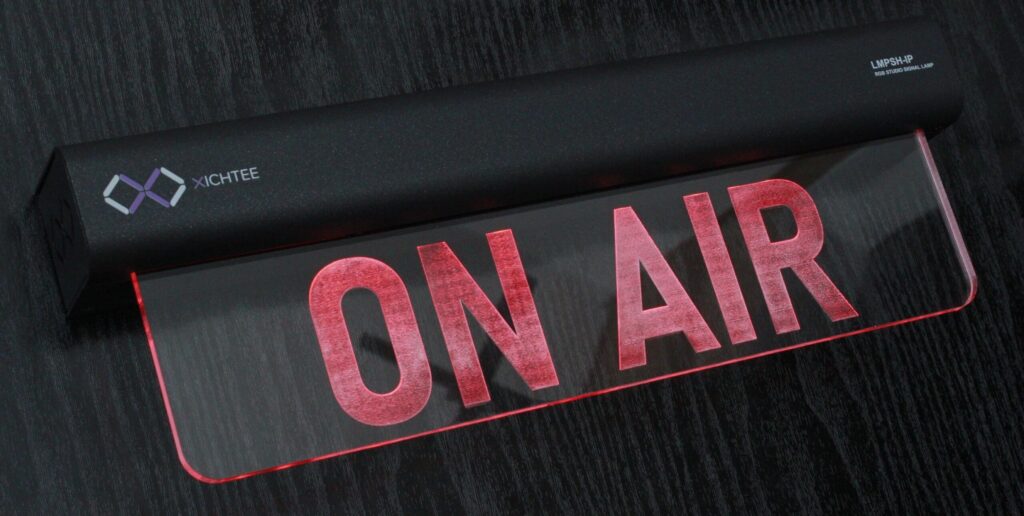
XICHTEE TSL Compatible Products
HRNL-25W
PRICE: 350 €
COMPACT ON AIR LAMP MODULE
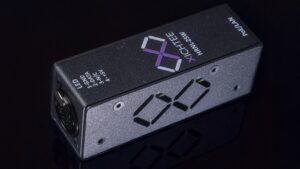
Can be used as a built-in module for OnAir lamps or as a standalone module, providing flexibility for various customer needs. Its primary use is to indicate OnAir status in professional environments such as TV stations, radio studios, OB vans, and more.
Understanding TSL Protocol: A Standard for Broadcast Communication
In today’s complex broadcast and live production environments, seamless communication between different systems and devices is essential. The TSL protocol has emerged as one of the most widely adopted standards for transmitting tally and text information across broadcast equipment. Originally developed to solve the challenge of incompatible tally systems, the TSL protocol provides a reliable, lightweight, and flexible way to exchange real-time control data, particularly for ON-AIR indicators and under-monitor display (UMD) labels.
The protocol is designed to run over serial or IP networks and is commonly used in studio control rooms, outside broadcast (OB) trucks, remote production setups, and anywhere dynamic status information needs to be shared between equipment such as video switchers, multiviewers, tally controllers, and camera systems.
TSL protocol excels in situations where systems from different vendors need to work together seamlessly. Its open structure and broad industry support have made it a foundational element in many broadcast infrastructures. By using TSL, engineers can ensure consistent tally logic and display data across a variety of platforms—greatly simplifying system design, reducing integration time, and improving reliability in fast-paced production workflows.
The protocol’s utility spans both traditional SDI-based environments and modern IP-based systems, making it suitable for both legacy infrastructure and future-facing broadcast operations.
What Is the TSL Protocol?
The TSL protocol, often referred to as TSL UMD (Under Monitor Display) protocol, is a lightweight, TCP or serial-based communication protocol designed to transmit real-time tally and text information between different pieces of broadcast hardware. The primary function of the protocol is to carry data about on-air (tally) states and dynamic label information, typically for multiviewer systems, tally controllers, cameras, routers, and production switchers.
Since its inception, the TSL protocol has become a de facto standard in the industry, widely implemented in television studios, OB (outside broadcasting) trucks, and live event environments. Its simplicity, flexibility, and widespread support make it a cornerstone of broadcast infrastructure.
Why Was It Created?
Before the introduction of TSL, broadcasters faced significant challenges when integrating tally systems from various vendors. Each manufacturer often had its own proprietary method for transmitting tally information, resulting in incompatibility, complexity, and increased integration costs.
TSL developed its protocol with the goal of standardizing tally communication, thereby streamlining interoperability between devices from different manufacturers. The TSL protocol allowed systems to exchange critical on-air status and labeling information in real time, without the need for custom coding or proprietary bridges. This not only simplified the setup of complex production systems but also made them more scalable and reliable.
Protocol Versions and Evolution
The most commonly implemented version is TSL Protocol v3.1, though newer iterations such as v4.0 and v5.0 have been introduced to address modern requirements. These later versions add features like bidirectional communication, support for additional metadata, and richer formatting options for under monitor displays.
TSL v3.1: Widely supported and perfect for basic tally and label transmission.
TSL v4.0: Introduced more robust data structures, better error handling, and extended character support.
TSL v5.0: Adds IP-based enhancements, such as multicast support, device discovery, and improved scalability for cloud and virtualized workflows.
Key Use Cases of the TSL Protocol
The TSL protocol has found its way into virtually every type of broadcast installation due to its versatility. Some of the most common use cases include:
1. Tally Control Systems
The protocol is best known for its use in tally systems, which indicate which cameras or video sources are live (on-air) or in preview. TSL protocol ensures this information can be sent from a switcher to camera tally lights, multiviewers, and even remote production setups.
2. Multiviewers and Monitor Walls
TSL protocol allows real-time text labels (UMD data) to be displayed under video sources in multiviewer setups. This is essential for giving operators clear and accurate information on what content they are viewing—such as input names, signal status, or tally states.
3. Remote and Distributed Production
As remote production becomes more prevalent, the ability to send tally and label data over IP networks is increasingly valuable. TSL protocol, particularly in its newer versions, supports IP transmission, making it suitable for decentralized workflows across wide-area networks.
4. Broadcast Automation Integration
Automation systems rely on timely and accurate information from other parts of the broadcast chain. TSL protocol provides an efficient and reliable way for automation controllers to read or set tally states, helping synchronize live and scheduled events.
5. Router Control Systems
Some matrix video routers use the TSL protocol to update their output monitor labels, ensuring that whatever source is routed to a destination is correctly identified. This reduces human error and improves clarity in fast-paced environments.
Industry Adoption and Interoperability
One of the main reasons for the widespread adoption of the TSL protocol is its open and well-documented specification. It has been embraced by virtually all major broadcast equipment manufacturers, including Grass Valley, Ross Video, Imagine, EVS and Evertz, among others.
A standout example is LAWO, a leading provider of broadcast and media infrastructure solutions. LAWO uses the TSL protocol extensively within its VSM (Virtual Studio Manager) product, which is a comprehensive broadcast control and workflow orchestration system. VSM Studio leverages the TSL protocol for real-time tally information, under-monitor display data, and status synchronization across various devices. This allows operators to control and monitor complex broadcast chains from a single interface while maintaining full tally logic across routers, switchers, and monitoring systems.
Because the TSL protocol is not vendor-locked, it enables seamless integration between LAWO’s systems and a broad range of third-party hardware. This open approach significantly reduces integration complexity and allows broadcast facilities to design flexible, best-of-breed production environments.
Thanks to this broad compatibility, the TSL protocol has become an essential element in mixed-vendor infrastructures and continues to play a key role in the transition to IP-based and virtualized production environments.
Why TSL Is Important for XICHTEE Products
At XICHTEE, we recognize the importance of industry-standard protocols in ensuring seamless communication across diverse broadcast systems. That’s why our products, such as the LMPSH IP RGB On-Air Lamp or HRNL-25W, are designed with full support for the TSL 3.1 protocol.
By implementing TSL protocol compatibility, our on-air lamps can receive real-time tally data directly from production switchers, routers, automation systems, or tally controllers, without requiring any proprietary interfaces or complex configuration. This allows broadcasters to integrate our visual signaling devices into existing infrastructures quickly and efficiently—whether in a live studio, a remote control room, or a mobile production environment.
Thanks to TSL support, XICHTEE’s on-air lamps can:
React instantly to tally events from any TSL-compatible device (e.g., preview, program, or custom states),
Display dynamic color states via RGB LED based on incoming tally information,
Operate over IP networks using PoE, with no need for separate power or serial wiring,
Integrate easily with all major control systems such as LAWO VSM and others.
This level of interoperability gives our customers the freedom to choose the tools they need without worrying about compatibility issues. Whether you are building a new studio from scratch or upgrading an existing setup, the presence of TSL protocol support in XICHTEE products ensures plug-and-play integration with the wider broadcast ecosystem.
Our goal is to provide not only high-quality hardware, but also future-proof, standards-compliant solutions that work in harmony with the tools broadcasters already use.
Conclusion
The TSL protocol continues to play a vital role in broadcast environments worldwide. Originally created to solve a specific problem—standardizing tally and label communication—it has grown into an indispensable protocol for live production, studio control, remote operations, and beyond.
Whether you’re designing a small studio or managing a large-scale event broadcast, the TSL protocol offers a reliable, scalable, and widely supported solution for device communication. With ongoing updates to meet modern IP and cloud-based production needs, TSL remains a cornerstone of professional broadcast technology.
